

Enclosures that rely on flexible membranes, or that expand and contract in response to pressure changes, are not suitable for Pulse testing.
- Containment laboratories and cleanrooms
- Gaseous fire suppression rooms
- Refrigeration chambers
- Vehicles
- Storage facilities
- Data centres
- Large storage tanks for liquids and gases
If you are considering testing an enclosure outside these typical applications, contact us for advice on suitability and appropriate test procedures.
Domestic dwellings
In a domestic dwelling, a Pulse test occurs entirely within the building envelope and requires no penetrations to the outside or any external pressure tappings.Whole building test
When testing an entire dwelling, the equipment should be positioned with at least 1m clearance around the air release nozzle in order to ensure an evenly distributed and non-turbulent burst of air. All internal doors and large storage cupboards within the dwelling must be open so that air released can dissipate freely throughout the building during the test.Room only test
When testing an individual room or other space, the equipment should be positioned with at least 1m clearance around the air release nozzle from furniture and other obstructions. All entry doors into the room must be closed. The rest of the dwelling must be at an equal pressure with the outside during the test, so that air escaping the room under test can move freely. To achieve this, a window or door to the outside elsewhere in the building should be open during the test.Commercial buildings
The testing procedure for commercial buildings, and rooms within them, is the same as for domestic buildings. However, care must be taken to ensure all ventilation openings and service penetrations are discovered and adequately sealed up.Other enclosures
When carrying out testing in other types of enclosure, the important considerations are:- Providing enough space (1m of free air) around the nozzle to allow an evenly distributed and non-turbulent air release to be established;
- How much air to release - for spaces much smaller or more airtight than a typical house, it may be more suitable to charge the air receiver to less than the maximum 10 bar. For larger or more leaky spaces, multiple air receivers may be required;
- The enclosure should be sufficiently rigid, as Pulse is a dynamic test, issues can be encountered if the enclosure can expand or contract during the measurement;
- If the enclosure is within another enclosure, e.g. a storage vessel within a building, the building fabric could potentially limit the amount of airflow which can be released from the enclosure under test by becoming pressurised itself. The extent of this effect will be dictated by the relative size of the enclosure. Ideally the air outside the enclosure under test should be at the same pressure as the external atmosphere.
Minimum enclosure size
To allow an evenly distributed and non-turbulent air release to establish, the smallest enclosure size that Pulse can be used to test is equivalent to a 1m wide by 1m deep by 2m high cube - approximately the size of a small lift/elevator or cupboard.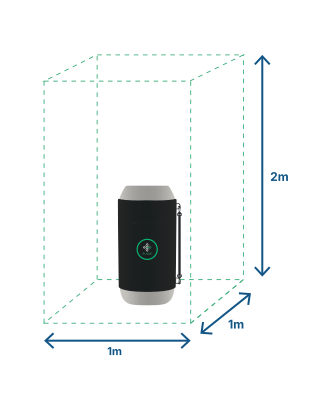
Test enclosures must be at least 2m³ in volume and have envelope area of at least 10m²